Real Twist and False Twist yarn: Two Distinct “Crafting Techniques”
Many people new to the textile industry often struggle to understand what real twist and false twist are, and their differences. This article avoids obscure technical jargon. With plain language and images, it answers all your questions.
What is real twist?
Simply put: During real twist processing, the yarn rotates continuously in the same direction, intertwines and bundles to form a stable spiral. Real twist genuinely twists the yarn together and locks in this permanent spiral structure. The twisted strands are finally consolidated into one yarn in a spiral form.
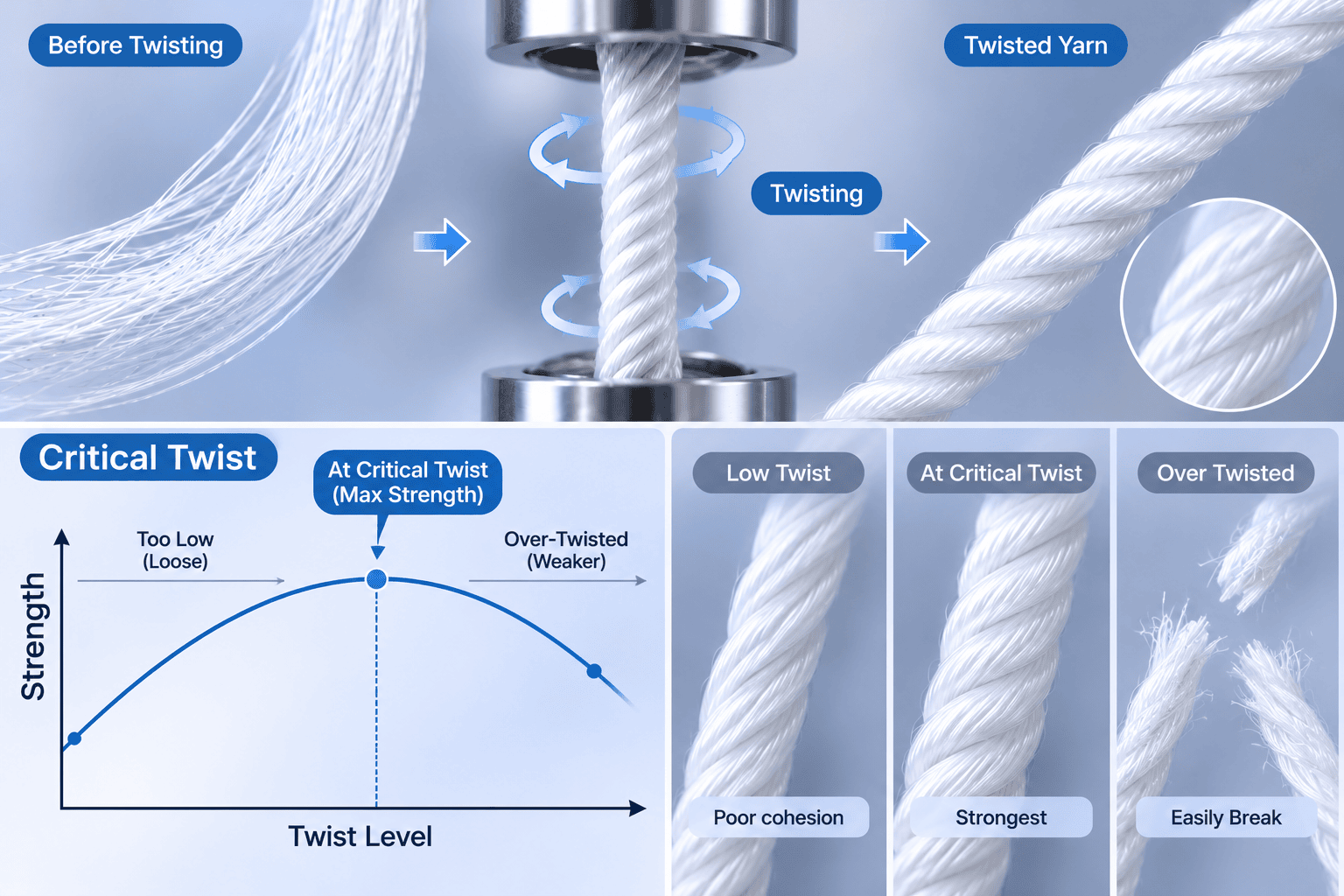
Let’s define a key term: Twist Count, also known as twist. It measures how tightly the yarn is twisted, indicating the number of spiral turns per unit length. It is like twisting ropes: for example, take several 10 cm rope segments, bundle and twist them 5 turns = low Twist Count ; twist 20 turns = high Twist Count.
Next we talk about the function of real twist: Real twist binds loose fibres inside the yarn tightly together, directly affecting the yarn’s cohesion, strength, fuzz level and hand feel. Common cotton yarn, sewing thread and high-tenacity industrial filament yarn mostly use real twist. Within the critical twist, the higher the twist, the tighter the yarn and better its strength, but the hand feel also becomes stiffer. Once exceeding the critical twist, strength will drop instead.
Supplementary explanation of critical twist: When twisting yarn: at first, the more you twist, the stronger the yarn. At a certain point, the yarn reaches its maximum strength. This exact twist level that delivers peak yarn strength is called critical twist. If you keep twisting further, the yarn will not get stronger; it turns brittle and more prone to breakage.
Fabrics made from real-twisted yarn:The fabric is dense, crisp and holds its shape well.It resists snagging and filament splitting well and has good abrasion resistance. When the fabric is stretched, filaments within the yarn do not shift easily, so the fabric surface remains stable and smooth.
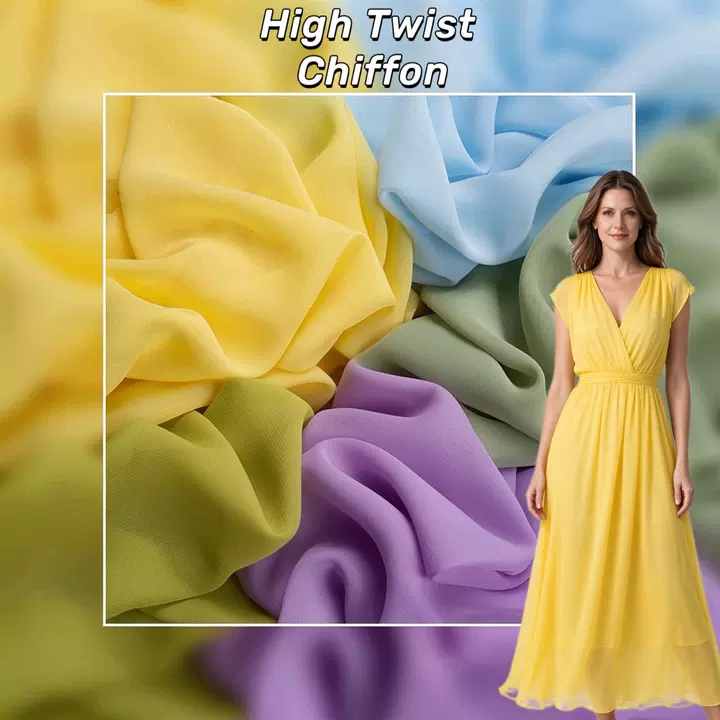
The downside is very low elasticity; it barely stretches. The yarn structure is dense with low bulk, stiff hand feel and lacks softness. Typical examples include high-twist chiffon, woven lining fabrics and high-tenacity industrial fabrics, most woven with real-twisted yarn.
What is false twist?
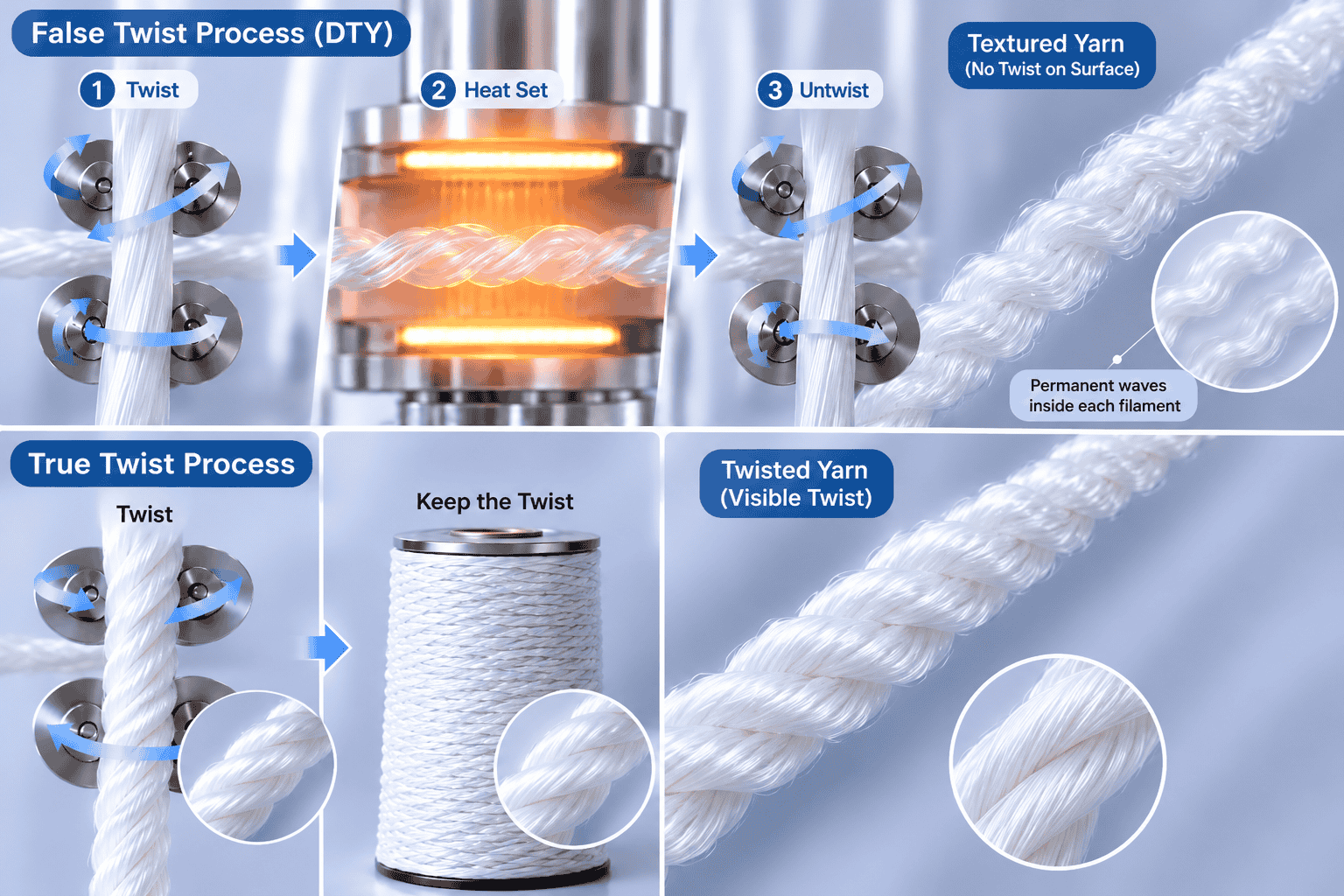
The false-twist process follows this sequence: apply twist, heat-set, then release the spiral structure.
Straight filaments enter the false-twist disc and is temporarily twisted into a spiral. While kept in twisted condition, the yarn is heat-set at high temperature. Each filament locks in this curved conformation. The yarn then passes through the false-twist disc and reverses rotation immediately to fully undo the temporary twist,and almost no visible spiral twist can be seen on the yarn surface.
However heat setting has permanently fixed the curved shape of each single filament. The temporary twist disappears, but crimp remains locked into each fine filament. That is why false-twisted yarn has zero twist count and feels bulky and elastic. After false-twist texturing, countless single filaments form continuous wave crimps. The whole yarn becomes bulky with good stretch elasticity, and the fabric cover also improves.
This process is quite similar to hair perming at a salon: hair is wrapped around curlers first. Wrapping around curlers uses heat to set a permanent curve in the hair. When curlers are removed, the curved shape stays. But false twist does not rely on curlers to create curves; it forms the crimp by twisting the filament bundle into a spiral. Nylon and polyester DTY (Draw Textured Yarn) used for yoga pants commonly adopts this false-twist texturing process.
Fabrics knitted from false-twist DTY yarn work entirely differently.The finished yarn has no leftover twist. Still, each tiny filament inside has wavy bends locked in by heat. These bent filaments press against each other, so the fabric feels full, soft and flexible. It can stretch and bounce back.For the same fabric thickness, it covers better, is less see-through and drapes nicely.
The downside: there is no real twist to hold the filaments tightly together. Sharp items may easily snag the fabric and pull filaments out. When pulled hard, the fine threads shift inside the cloth. The fabric also shrinks more after washing.Yoga cloth, stretch sportswear fabric and elastic mesh are usually made by knitting DTY false-twist yarn.
Please feel free to contact us for free fabric samples