
What are the Types of Spandex Yarn? Differences and Applications of Their Fabric Properties
The core property of spandex fibres is high elasticity and high recovery. It is a core functional fibre for sportswear, intimate apparel, swimwear and elastic pants.
But pure spandex fibres can hardly be woven into fabric alone. The elasticity in daily fabrics is achieved by making elastic yarns through different composite processes, with spandex fibres matched with cotton, nylon and polyester.
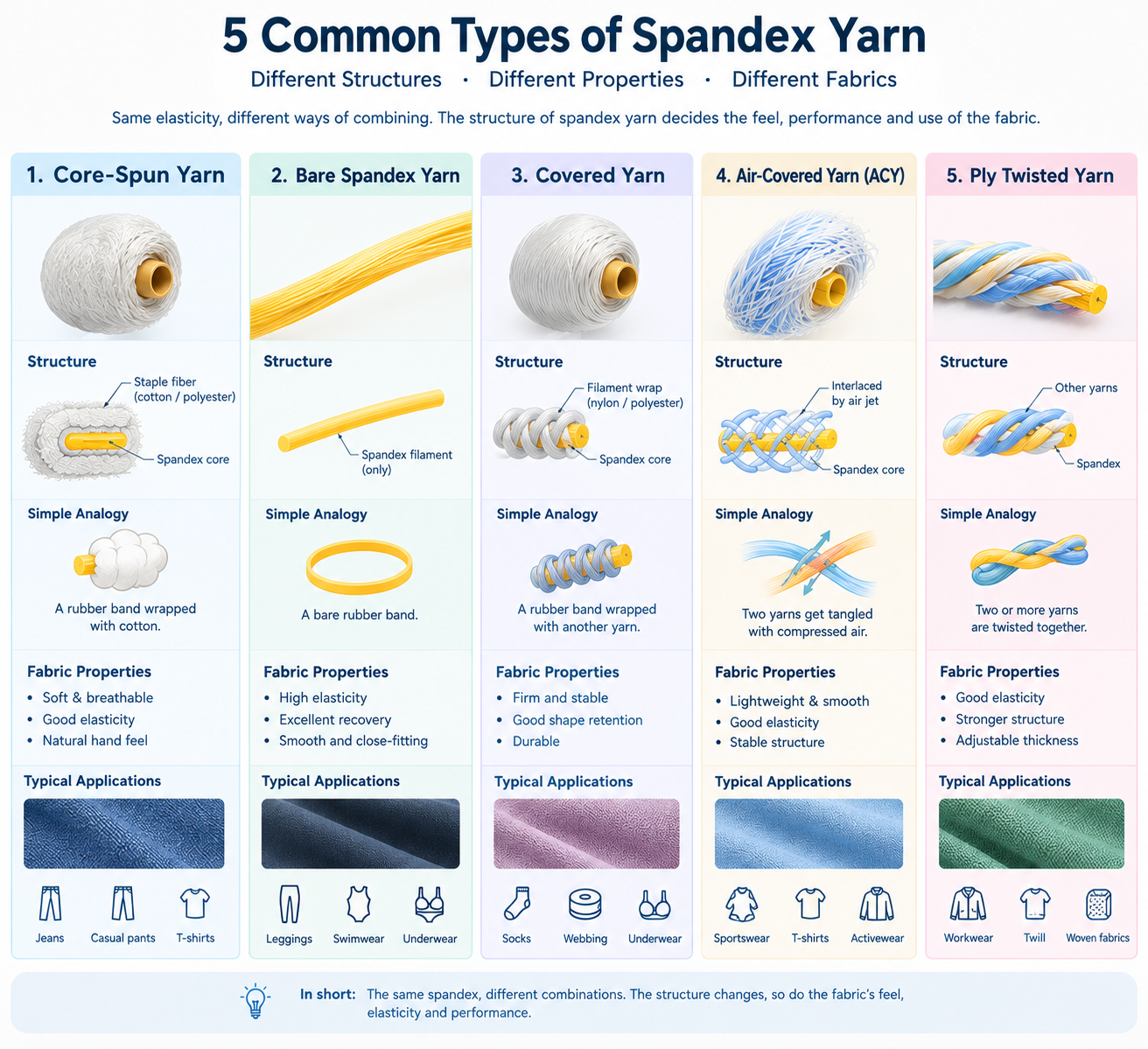
The five most commonly used types in the market are: core spun yarn, bare spandex yarn, covered yarn, air covered yarn (ACY), and ply twisted yarn. Different process structures lead to fully different fabric hand feel, elasticity, smoothness, cost and applicable scenarios. Below we use practical textile industry logic to clearly explain the differences, fabric features and applicable reasons.
1. Core Spun Yarn
Continuous spandex fibres filament acts as the inner elastic core. The outer layer is fully covered with staple fibre such as cotton or polyester, compactly wrapped via traditional spinning process. This is the structure of “staple fibre wrapping spandex fibres”.
Inner spandex fibres are solely responsible for providing elasticity. Outer staple fibre decides fabric hand feel, appearance, air permeability and skin friendliness. The two types of fibre perform their own duties and complement each other’s weaknesses.
✅【Simple Metaphor & Plain Language Version 】 We liken spandex to a rubber band. Core Spun Yarn is like a rubber band wrapped with cotton. The rubber band handles stretch and recovery, while the outer cotton creates cotton fabric hand feel.
Fabric Core Features made from this yarn
It is the optimal yarn balancing cotton hand feel and skin friendly elasticity, also mainstream for civilian casual elastic fabrics.
- Natural elasticity without tightness: Stretch and recovery are mild, no tight binding feeling, no pressure on skin after long time wear;
- Restore base material hand feel and appearance: If outer layer is cotton, it delivers pure cotton touch and luster, no chemical fibre look, retains softness and air permeability of ordinary cotton fabric;
- Smooth and fine fabric surface: Dense staple fibre wrapping, no extra fibre fuzz or texture marks, good fabric forming effect.
Main Applications
- Stretch denim fabric: Ordinary denim is hard with zero elasticity and limited movement. After adding spandex fibres core spun yarn, it retains the hard, wear resistant and retro texture of denim, meanwhile adds cross direction elasticity, no restriction when squatting or walking. It is standard raw material for stretch jeans.
- Cotton stretch casual pants fabric & undershirts fabric: Solve the problem that pure cotton fabric has no elasticity, tight wearing and easy deformation. It keeps pure cotton skin friendliness and air permeability, very suitable for daily commuting and home wear.
Core Advantage Summary: Retain original texture of staple fibre fabric while making up the lack of elasticity. It is the first choice for skin friendly daily stretch fabrics.
2. Bare Spandex Yarn
The only raw material of spandex fibres without pre composite processing. It is pure spandex fibres filament, without wrapping, twisting or interlacing procedures. During weaving, it is fed into loom synchronously with nylon or polyester yarn and combined into fabric in weaving process.
✅【Simple Metaphor & Plain Language Version】 We liken spandex to a rubber band. It is a bare rubber band, not combined with other yarns beforehand. When weaving on loom, the rubber band and face yarn are fed into loom together and interwoven during fabric forming.
Fabric Core Features made from this yarn
Maximum elasticity, highest stretching limit and strongest body wrapping effect. Fabric is ultra soft and highly fitted. But it has poor stability when used alone and must be woven together with other filament yarns.
Main Applications
- Leggings & Tight sports fabric: Require huge stretching capacity, no restriction for deep squat, split and large range movement. The high elasticity of bare spandex fibres perfectly meets demands of high intensity sports.(SEE Leggings & sports fabric & Swim fabric of Natudon)
- Swim fabric: Fits body line after stretching, no water trapping and no shaking when entering water. Matched with nylon base material, it meets high elasticity and close fitting requirements of swimwear.
- Underwear fabric: The spandex fibre content can be adjusted freely to control fabric elasticity. It is core raw material for all kinds of high elastic intimate knit fabrics.
Core Advantage Summary: Top level elasticity, ultra close fitting. First choice for all ultra high elastic tight fitting fabrics.
3. Covered Yarn (See Natudon’s fabrics made from Covered Yarn)
Also take spandex fibres filament as core. Different from core spun yarn: outer layer does not use staple fibre, uses nylon or polyester filament for spiral wrapping.
Divided into two processes: single covered yarn (single layer filament wrapping), double covered yarn (two layers reverse wrapping). Winding layer quantity decides yarn compactness and stability.
Simple distinction: Core spun yarn = “cotton wrapping core”; Covered yarn = “long filament winding core”.
✅【Simple Metaphor & Plain Language Version 】 We liken spandex to a rubber band. Wrap a long filament tightly and spirally around a rubber band. Single layer winding is single covered yarn, two layers reverse winding is double covered yarn.
Fabric Core Features made from this yarn
Fabric has Firm Stretch, extremely stable recovery and resistance to repeated stretching. Compact structure, not easy to deform. But no soft cotton touch, hand feel is dry and smooth.
Double covered yarn is firmer than single covered yarn, anti loosening and not easy to degrade elasticity, higher durability, but fabric will be slightly stiffer.
Main Applications
- High stretch socks fabric & elastic band: Sock cuffs and elastic webbing need repeated stretching, high frequency recovery and no loosening. Covered yarn has stable structure, not easy to deform after repeated stretching, maintains long time fitting without slipping off. It is special yarn for socks and elastic webbing.
- Shapewear fabric & compression fabric: Dense outer filament wrapping, sufficient elastic supporting power, can provide slight shaping effect. Meanwhile fabric surface is smooth and anti pilling, suitable for all kinds of tight shapewear.
Core Advantage Summary: Stable structure, fatigue resistance, suitable for elastic and intimate fabrics requiring long lasting recovery and anti loosening.
4. Air Covered Yarn (ACY)
No winding or compact wrapping. Rely on high pressure air flow to blow and interlace spandex fibres filament and nylon/polyester filament to bind together. Uniform tiny interlacing nodes form on yarn, whole yarn structure is fluffy and thin.
Essential difference from covered yarn: Covered yarn is formed by mechanical spiral winding. Air covered yarn is interlaced naturally by air flow, no hard winding marks on surface.
✅【Simple Metaphor & Plain Language Version 】 Two yarns pass through high pressure air nozzle together. Air flow blows two yarns to interlock and bind together. Not manually wound circle by circle; interlacing knots are formed by air.
Fabric Core Features made from this yarn
Among five elastic yarns, it is finest, softest with smoothest and no visible core marks on fabric surface. Fluffy and rigid free yarn, even elasticity distribution, excellent fabric air permeability, high production efficiency and good cost performance.
Disadvantage: Elastic supporting power and tensile resistance ability are weaker than double covered yarn.
Main Applications & Adaptation Reasons
- Lightweight sport fabric & quick dry knit fabric: Fabric is lightweight on body, elasticity fits body, no stuffy sweat and heat accumulation. Perfect for running, fitness and other lightweight sport apparel.
- Fine woven elastic fabric: Clean fabric surface without texture marks or fibre fuzz. Finished fabric has delicate premium texture, suitable for high end thin elastic fashion clothes.
Core Advantage Summary: Light, soft, smooth, good air permeability, low mass production cost. Mainly for lightweight, mark free premium comfortable elastic fabrics.
5. Ply Twisted Yarn
Simplest composite process: Place spandex fibres yarn and ordinary nylon/polyester/cotton yarn parallel, directly twist together via twisting process. No wrapping or interlacing. Only rely on twist to combine two yarns into one.
Different from all covered yarn types: It has no core wrapping structure, it is double yarn twisted structure.
✅【Simple Metaphor & Plain Language Version 】 Two separate yarns are placed side by side. Machine twists them together like twisting fried dough twist. No yarn wraps another, two yarns twist mutually.
Fabric Core Features made from this yarn
It has best fabric firmness and hand feel, not easy to collapse or wrinkle. Its elasticity is low stretch instead of high stretch, maximally retains original fabric silhouette and texture.
Elasticity level and fabric hardness can be flexibly adjusted by changing twist and raw material ratio, excellent silhouette stability.
Main Applications
- Elastic workwear & elastic suit fabric: Workwear and suit require structured silhouette, no collapse and good shape retention. Ply twisted yarn only adds slight stretch, solves tight feeling when sitting long or raising arms, will not destroy neat fabric silhouette.
- Elastic gabardine: Retain clear texture and drape of gabardine, slightly improve movement space when wearing, balance fabric texture and practicality.
Core Advantage Summary: Keep silhouette, anti wrinkle, low stretch and not tight on body. Mainly for stiff workwear and formal wear elastic fabrics.